Blog Header Text

For questions you can contact Adam at: adamchartley "at" gmail "dot" com or Jason at: jasoncppk "at" yahoo "dot" co "dot" uk

Monday, 1 January 2007

County List

I'm still working on the formatting for this

Category A
Species which have been recorded in an apparently natural state at least once since the formation of the OOS in 1921.

* Number of birds recorded are shown for Rare (Ra) and Very Rare (VR) visitors. For some highly mobile or flocking species the number of records, shown in square brackets, is given either instead of, or in addition to, the number of individuals recorded. An analysis is given of the number of birds recorded in total for the county, followed by the number in the last decade (1994-2003).


Common name County status Record type
1 Red-throated Diver Ra, WV B 42 8
2 Black-throated Diver VR, WV B 10 3
3 Great Northern Diver Ra, WV B 23 7
4 Pied-billed Grebe VR, Va A 2 1
5 Little Grebe Co,Br,Re,WV E (5) [b]
6 Great Crested Grebe Co,Br,Re,WV E (20) [b]
7 Red-necked Grebe Ra, WV B 59 14
8 Slavonian Grebe Ra, WV C 95 26
9 Black-necked Grebe Ra, WV & PM C 122 47
10 Fulmar VR, Va B 11 0
11 Manx Shearwater Ra, Va B 31 2
12 European Storm-petrel VR, Va B 8 0
13 Leach's Storm-petrel Ra, Va B 24 2
14 Northern Gannet Ra, Va B 38 7
15 Great Cormorant Co, Re & WV D w50 at Far, LWV
16 Shag Ra, Va C 92 8
17 Eurasian Bittern Ra, WV C 74 24
18 Little Bittern VR, Va A 2 0
19 Night Heron VR, Va A 5 1
20 Squacco Heron VR, Va A 1 0
21 Cattle Egret VR, Va A 1 0
22 Little Egret Un, Re, PM, OB B 202 201
23 Great White Egret VR, Va
24 Grey Heron Co, Br, Re E (5) [b]
25 Purple Heron VR, Va B 11 1
26 White Stork VR, Va B 14 6
27 Glossy Ibis VR, Va A 5 [2] 4 [1]
28 Eurasian Spoonbill VR, Va B 6 1
29 Mute Swan Co, Br, Re & WV E (30)
30 Bewick's Swan Un, WV D
31 Whooper Swan Un, WV D
32 Bean Goose VR,WV B 34 [14] 8
33 Pink-footed Goose VR,WV B 74 [22] 7
34 White-fronted Goose Un, WV B
35 Greylag Goose Un, Br, Re D
36 Barnacle Goose VR, WV D 38 [5] 10
37 Brent Goose Ra, WV D
38 Ruddy Shelduck VR, Va A n/a n/a
39 Common Shelduck Un, Br, Re D
40 Eurasian Wigeon VC, WV D w50
41 American Wigeon VR, Va A 3 2
42 Gadwall Co, Br, Re & WV D w10
43 Common Teal VC, WV D w30
44 Green-winged Teal VR, Va B 6 5
45 Baikal Teal VR, Va
46 Mallard VC, Br, Re & WV E (100)
47 Pintail Un, WV D
48 Garganey Un, PM C
49 Blue-winged Teal VR, Va A 1 0
50 Shoveler Co, WV D w10
51 Red-crested Pochard Un, WV D
52 Common Pochard VC, WV E (100) [b]
53 Ring-necked Duck VR, Va B 19 6
54 Ferruginous Duck VR, Va B 21 0
55 Tufted Duck VC, Br, Re & WV E (100) [b]
56 Greater Scaup Un, WV C
57 Lesser Scaup VR, Va A 1 1
58 Common Eider VR, Va B 11 [6] 0
59 Long-tailed Duck Ra, WV C 23 5
60 Common Scoter Un, PM C
61 Surf Scoter VR, Va B 1 1
62 Velvet Scoter Ra, WV B 26 [12] 1
63 Common Goldeneye Co, WV D w20 at Far, LWV
64 Smew Un, WV C
65 Red-breasted Merganser Un, WV C
66 Goosander Co, WV D
67 Honey Buzzard VR,SV B 48 33
68 Black Kite VR, Va A 2 2
69 Red Kite Un, Br, Re C
70 White-tailed Eagle VR, Va A 6 0
71 Marsh Harrier Un, WV & PM B
72 Hen Harrier Un, WV D
73 Montagu's Harrier Un, OB, SV & PM B
74 Northern Goshawk Un, Re B
75 Eurasian Sparrowhawk Co, Br, Re E [b]
76 Common Buzzard Co, Br, Re D
77 Rough-legged Buzzard VR, WV B 26 3
78 Golden Eagle VR, Va B 1 0
79 Osprey Un, PM C
80 Common Kestrel Co, Br, Re E [b]
81 Red-footed Falcon VR, Va A 3 1
82 Merlin Un, WV C
83 Hobby Un, Br, SV D
84 Peregrine Falcon Un, Br, Re & WV C
85 Black Grouse VR, Va B 3 0
86 Grey Partridge Co, Br, Re E (10) [b]
87 Common Quail Un, Br, SV D
88 Water Rail Un, Br, Re & WV D
89 Spotted Crake VR, Va B 13 2
90 Corn Crake VR, PM B 9 since 1947 6
91 Moorhen VC, Br, Re E (20)
92 Eurasian Coot VC, Br, Re & WV E (50)
93 Common Crane VR, Va B 51 [7] 14 [5]
94 Oystercatcher Ra, PM D
95 Black-winged Stilt VR, Va A 4 [2] 0
96 Avocet Ra, PM C 40 11
97 Stone Curlew Ra, OB, SV C
98 Little Ringed Plover Co, Br, SV & PM D
99 Ringed Plover Co, OB, SV & PM D
100 Kentish Plover VR, Va B 3 0
101 Dotterel VR, PM B 21 1
102 European Golden Plover VC, WV D w50
103 American Golden Plover VR, Va
104 Grey Plover Un, PM D
105 Sociable Plover VR, Va A 1 0
106 Northern Lapwing Co, Br, Re & WV E (100) [b]
107 Red Knot Un, PM C
108 Sanderling Un, PM D
109 Little Stint Un, PM D
110 Temminck's Stint Ra, PM B 23 11
111 Pectoral Sandpiper VR, Va B 9 4
112 Curlew Sandpiper Un, PM C
113 Purple Sandpiper VR, PM B 17 6
114 Dunlin Co, PM & WV D
115 Ruff Co, PM & WV D
116 Jack Snipe Un, WV D
117 Common Snipe Co, Br, Re & WV D w10
118 Great Snipe VR, Va A 8 0
119 Woodcock Co, Br, Re & WV D
120 Black-tailed Godwit Un, PM D
121 Bar-tailed Godwit Un, PM D
122 Whimbrel Un, PM D
123 Eurasian Curlew Co, Br, Re D
124 Spotted Redshank Un, PM C
125 Common Redshank Co, Br, Re & PM D
126 Greenshank Un, PM D
127 Lesser Yellowlegs VR, Va A 4 2
128 Green Sandpiper Co, PM &WV D
129 Wood Sandpiper Un, PM C
130 Common Sandpiper Co, PM E [b]
131 Spotted Sandpiper VR, Va A 2 0
132 White-rumped Sandpiper VR, Va
133 Marsh Sandpiper VR, Va
134 Turnstone Un, PM D
135 Red-necked Phalarope VR, PM B 7 1
136 Grey Phalarope Ra, Va B 32 1
137 Pomarine Skua VR, Va B 6 1
138 Arctic Skua Ra, Va B 18 6
139 Long-tailed Skua VR, Va B 4 2
140 Great Skua VR, Va B 13 7
141 Mediterranean Gull Un, WV, PM B
142 Franklin's Gull VR, Va A 1 1
143 Little Gull Un, PM D
144 Sabine's Gull VR, Va A 2 2
145 Bonaparte's Gull VR, Va A 1 1
146 Black-headed Gull VC, Br, Re & WV E (500) [b]
147 Ring-billed Gull VR, Va B 2 2
148 Common Gull Co, WV & PM D w20
149 Lesser Black-backed Gull VC, Re & WV E (250)
150 Yellow-legged Gull Un, WV C
151 Caspian Gull Larus cachinnans Ra, WV
152 Herring Gull VC, WV D w100
153 Iceland Gull Ra, WV B 26 14
154 Glaucous Gull Ra, WV B 23 11
155 Great Black-backed Gull Co, WV D
156 Kittiwake Un, PM D
157 Gull-billed Tern VR, Va A 1 1
158 Sandwich Tern Un, PM D
159 Roseate Tern VR, PM B 5 3
160 Common Tern Co, Br, SV & PM E [b]
161 Arctic Tern Un, PM D
162 Little Tern Un, PM D
163 Whiskered Tern VR, Va A 1 0
164 Black Tern Un, PM D
165 White-winged Black Tern VR, Va A 7 4
166 Common Guillemot VR, Va B 4 0
167 Razorbill VR, Va B 5 0
168 Little Auk VR, Va B 17 3
169 Puffin VR, Va B 3 0
170 Stock Dove Co, Br, Re E (30)
171 Woodpigeon VC, Br, Re E (500)
172 Collared Dove VC, Br, Re E (50)
173 Turtle Dove Un, Br, SV D
174 Oriental Turtle Dove VR, Va
175 Common Cuckoo Co, Br, SV E [b]
176 Barn Owl Un, Br, Re D
177 Tawny Owl VC, Br, Re E [b]
178 Long-eared Owl Un, Br, Re C
179 Short-eared Owl Un, WV D
180 Eurasian Scops Owl VR, Va A
181 European Nightjar Ra, PM B N/a N/a
182 Common Swift VC, Br, Re E (100)
183 Alpine Swift VR, Va A 5 1
184 Common Kingfisher Co, Br, Re E [b]
185 European Bee-eater VR, Va B 28 [5] 20 [3]
186 European Roller VR, Va A 3 0
187 Hoopoe Ra, PM B 48 8
188 Wryneck Ra, PM B 62 9
189 Green Woodpecker Co, Br, Re E [b]
190 Great Spotted Woodpecker Co, Br, Re E [b]
191 Lesser Spotted Woodpecker Un, Br, Re D
192 Wood Lark VR, PM B 5 since 1972 2
193 Sky Lark VC, Br, Re E (20)
194 Sand Martin VC, Br, SV E (100) [b]
195 Barn Swallow VC, Br ,SV E (100)
196 Red-rumped Swallow VR, Va A 1 1
197 House Martin VC, Br, SV E (100)
198 Richard's Pipit VR, Va B 3 1
199 Tree Pipit Ra, OB, SV C
200 Meadow Pipit Co, Br, Re & WV E (25) [b]
201 Rock Pipit Un, PM D
202 Water Pipit Un, PM C
203 Buff-bellied Pipit VR, Va
204 Yellow Wagtail Co, Br, SV & PM E (25) [b]
205 Grey Wagtail Co, Br, Re & WV E (5) [b]
206 Pied Wagtail VC, Br, Re & WV E (20)
207 Waxwing VR, WV B [89] [32]
208 Dipper Ra, OB, Re D N/a N/a
209 Wren VC, Br, Re E
210 Dunnock VC, Br, Re E
211 Robin VC, Br, Re E
212 Common Nightingale Un, Br, SV D
213 Bluethroat VR, Va B 2 0
214 Black Redstart Un, PM C
215 Common Redstart Un, PM D
216 Whinchat Un, PM D
217 Stonechat Co, PM & WV D
218 Northern Wheatear Co, PM D
219 Black-eared Wheatear VR, Va A 1 0
220 Ring Ouzel Ra, PM D
221 Blackbird VC, Br, Re & WV E (20)
222 Fieldfare VC, WV E (w100) [b]
223 Song Thrush VC, Br, Re & WV E (10)
224 Redwing VC, WV E (w100) [b]
225 Mistle Thrush VC, Br, Re E (10)
226 Cetti's Warbler Un, Br, Re D
227 Grasshopper Warbler Un, Br, SV D
228 Aquatic Warbler VR, Va B 1 0
229 Sedge Warbler Co, Br, SV E
230 Marsh Warbler VR, Va B 5 2
231 Reed Warbler Co, Br, SV E [b]
232 Icterine Warbler VR, Va B 2 [1] 0
233 Dartford Warbler VR, Va B 4 2
234 Lesser Whitethroat Co, Br, SV E [b]
235 Common Whitethroat Co, Br, SV E
236 Garden Warbler Co, Br, SV E [b]
237 Blackcap Co, Br, SV E (all winter records)
238 Yellow-browed Warbler VR, Va B 3 2
239 Wood Warbler Ra, Br, SV D N/a N/a
240 Common Chiffchaff VC, Br, SV E (all winter records)
241 Iberian Chiffchaff VR, Va A 1 1
242 Willow Warbler VC, Br, SV E
243 Goldcrest VC, Br, Re E (10) [b]
244 Firecrest Un, Br, Re & PM D
245 Spotted Flycatcher Un , Re, SV E [b]
246 Pied Flycatcher Ra, OB, SV & PM D N/a N/a
247 Bearded Tit VR, Va B 31 [12] 0
248 Long-tailed Tit VC, Br, Re E (20)
249 Marsh Tit Co, Br, Re E [b]
250 Willow Tit Un, Br, Re D
251 Coal Tit VC, Br, Re E (10)
252 Blue Tit VC, Br, Re E (20)
253 Great Tit VC, Br, Re E (20)
254 Eurasian Nuthatch Co, Br, Re E [b]
255 Eurasian Treecreeper Co, Br, Re E [b]
256 Golden Oriole VR, PM B 20 3
257 Red-backed Shrike VR, SV B 5 since 1967 2
258 Lesser Grey Shrike VR, Va A 1 0
259 Great Grey Shrike VR, WV B 66 5
260 Woodchat Shrike VR, Va B 7 0
261 Eurasian Jay Co, Br, Re E (5)
262 Magpie VC, Br, Re E (20)
263 Spotted Nutcracker VR, WV A 4 [2] 0
264 Western Jackdaw VC, Br, Re E (200)
265 Rook VC, Br, Re E (200)
266 Carrion Crow VC, Br, Re E (50)
267 Common Raven Ra, Re B N/a N/a
268 Common Starling VC, Br, Re & WV E (1000)
269 Rose-coloured Starling VR, Va A
270 House Sparrow VC, Br, Re E (100)
271 Tree Sparrow Un, Br, Re D
272 Chaffinch VC, Br, Re & WV E (100)
273 Brambling Un, WV D
274 European Serin VR, Va B 4 0
275 European Greenfinch VC, Br, Re E (30)
276 Goldfinch VC, Br, Re E (20)
277 Siskin Co, OB, WV D
278 Linnet VC, Br, Re E (30)
279 Twite VR, WV B 24 8
280 Common Redpoll Ra, WV B 4 1
281 Lesser Redpoll Co, OB, WV D
282 Two-barred Crossbill VR, Va A 1 1
283 Common Crossbill Un, Br, Re & WV D
284 Bullfinch Co, Br, Re E (10)
285 Hawfinch Un, Br, Re D
286 Lapland Bunting VR, Va B 1 0
287 Snow Bunting Ra, WV B 43 8
288 Yellowhammer VC, Br, Re E (50)
289 Cirl Bunting VR, Va B 5 since 1982 0
290 Little Bunting VR, Va B 2 0
291 Reed Bunting VC, Br, Re E (10)
292 Corn Bunting C, Br, Re D
293 Baltimore Oriole VR, Va A 1 1

Sunday, 1 January 2006

Identification Articles

Tree/Meadow Pipit
The owner of the excellent Manchester Birding website has very kindly allowed me to use a link to an article he wrote: Tree Pipit vs. Meadow Pipit

Gulls
Immature Caspian & Yellow-legged: Rudy's Gull Index
Good ID articles about all the main gull species: Gulls in the West Midlands
Good ID articles about all the main gull species: Birder's Playground
Yellow-legged Gulls: More than Just a Mantle

Saturday, 15 January 2005

Chinnor Quarry


Location

The site is easy to find by taking Hill Road out of Chinnor up towards Bledlow. Old Kiln Lakes is signposted from the new roundabout just over the railway bridge. Park at The Chinnor and Princes Risborough Railway for a longer walk around the whole site or on one of the streets in the housing development for quicker access to the Lakes and a shorter walk. 

A: Parking (Chinnor and Princes Risborough Railway). The car park can get full when trains are running - check C&PR Railway website for timetable
B: Parking (Ridgeway - limited spaces and off road)
C: Parking (Roadside, please be considerate of residents)

Background

The decommissioned Rugby Cement quarry has recently been developed by Taylor Wimpey homes and has been left as an open access community facility and nature reserve and is developing into a great local wetland site. Taylor Wimpey still own the site and carry out a basic management plan. The deeper ‘Blue Lagoon’ lake houses a Geological SSSI - this lake is not accessible but is viewable down from the BBOWT Oakley Hill Reserve.

The site offers many add ons for a longer day out or family visit. It is located next to the Chinnor and Princes Risborough Heritage Railway that run regular services to Princes Risborough and back (www.chinnorrailway.co.uk). The Ridgeway National Trail runs through the site offers many options for longer walks and there are two BBOWT Nature Reserves in close proximity (Chinnor Hill and Oakley Hill - www.bbowt.org.uk/nature -reserves) offering additional Butterfly, Woodland and Chalk Grassland interest. Chinnor offers a range of cafes and pubs. Note there are no toilet facilities on site.

Nestled between the village of Chinnor and the foot of the Chiltern escarpment the site holds a range of habitat from a complex of lakes with varying depth, muddy and stony ‘beaches’ to Chiltern woodland, grassland and large areas of scrub. A compact site that works perfectly both for a short lunch time birding walk for an hour or a longer morning or afternoon trip.

Frustratingly the site is popular with local dog walkers and the lack of signage means they will often cause disturbance to birds using the lakes - visitors are kindly asked to walk at a respectful distance from the waters edge.


Red Route
Walk from the station car park around the edge of the chalk cliff - interest in the chalk grassland reversion, geology of the chalk and towards the first seasonal pool. Walk up, along and over the scrubby ‘shoulder’ towards the fishing lake on your right and seasonally wet willow and birch scrub on your left. Carry on and turn left along the broken concrete track between hawthorn scrub and sycamore copse. Turn right at the end of the fence line and walk through bramble scrub and to the first of two viewing screens over the lakes. Please do not pass here to avoid disturbance of birds on the water.

Blue Route
Double back along the concrete track and turn left taking the concrete track down through more hawthorn (and Juniper) scrub and sycamore copse to the second viewing screen with views across the water and the muddy/stony beaches. Carry on along the fence line for views across the chalk grassland reversion and scrub to the corner with good higher views along the lakes and escarpment ridge and woodland. Keep right and walk back along the woodland edge of the site back to the fishing lake.

Green Route
Either take a short drive up and park off the hill in the car park on the Ridgeway or take a longer walk from the end of the site up on to the Ridgeway and walk onto the BBOWT Oakley Hill reserve (good site for Butterflies) for good views down over the deeper ‘Blue Lagoon’ lake with it’s steep cliffs of exposed chalk (take your scope for better views of the water.) The Reserve is linear and doesn’t offer a round trip so double back onto the Ridgeway.


The Site

Winter

The main winter interest lies on the water (A) with large numbers Teal, Pochard, Little Grebe and Tufted Duck overwintering with occasional records of Gadwall, Shoveler and Wigeon. Winter Thrushes are common but in small numbers. The site attracts a good number of Gulls with Common Gull often recorded. Marsh Tit have been recorded venturing down from the Chiltern woodland (B) and a scan of the ridge line will often bring Raven and the occasional Peregrine amongst the Buzzards and Red Kites. Tawny Owl can frequently be heard calling. Meadow Pipits and Linnet will often be recorded in the grassland reversion (C) areas.


Spring
The wide range of scrub (D) and woodland brings good selection of warblers to the site including Chiffchaff, Whitethroat, Lesser Whitethroat, Blackcap, Garden Warbler and Willow Warbler. Peregrine and Hobby can often be seen hunting and hawking. At least one pair of Little Ringed Plover (E) have bred on the stony islands in recent years. Other waders such as Lapwing and Oystercatcher have looked like establishing territory but frequent disturbance from dog walkers has prevented any attempts.

Passage Migrants
The site attracts a good number of both spring and autumn migrants on passage. Common Sandpiper are the highlight with birds often long staying (E). Green Sandpiper are regular visitors as are Lapwing and Oystercatcher with Wood Sandpiper being a highlight in recent years. Wheatear, Redstart, Yellow Wagtail and Spotted Flycatcher have been recorded in the Autumn along with Sand Martin and longer staying Stonechats often seen favouring the larger areas of bramble scrub (F).

Wednesday, 5 January 2005

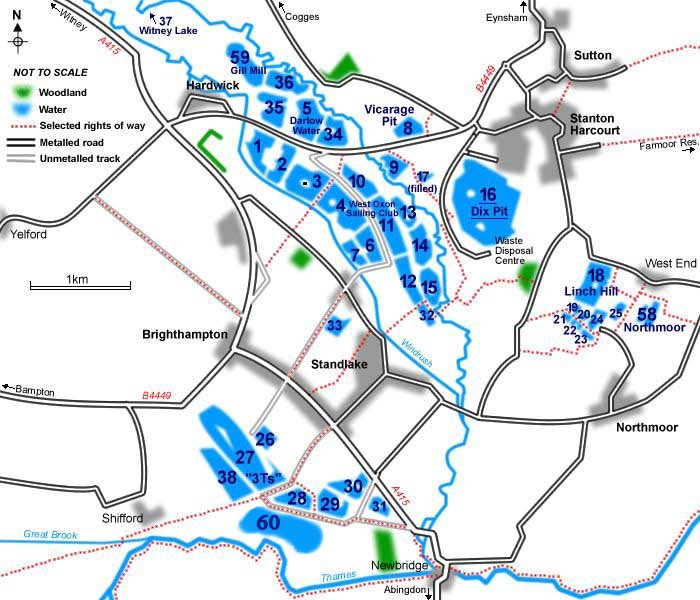
Lower Windrush Valley Gravel Pits Complex

This is a complex of gravel excavation pits located to the west of Oxford along the Windrush Valley. The most well known pits are Dix Pit and Pit 60. For more detailed information on some of the pits see the Lower Windrush Valley Project blog or the OOS LWV site page

Map courtesy of David Dunford

Sunday, 2 January 2005

Otmoor Site Guide

Blogs: Otmoor Birding, The Otmoor Blogger

Introduction
The Otmoor basin forms the floodplain of the River Ray. It is a natural wetland that in the past flooded during the winter and then gradually dried out during the spring and summer to sedge, reed beds and water meadows. The people in the surrounding villages harvested wildfowl and fish and during the summer they grazed and hayed the meadows. More recently the land was drained and fields were given over to arable farming. A large area was owned by the Ministry of Defence and this area remained as wet rough grazing.

The RSPB has acquired almost one thousand acres in the area and have set about returning this to lowland wet grassland, which is the preferred breeding habitat for Lapwing, Snipe, Redshank and Curlew. In addition they have created a fifty five acre reed bed, encouraged scrub in some areas and developed scrapes and wet features throughout the site. There is a car park, a large hide, two viewing screens and several permissive footpaths. It forms a very extensive reserve. The list of species recorded here is well over two hundred and includes some notable rarities including: Glossy Ibis, Lesser Yellowlegs, Purple Heron, Great White Egret, Marsh Warbler, Red Footed Falcon and Spoonbill. In a normal year we would expect to see over one hundred and fifty different species. The seasonal sections below give an indication of what one might expect to see during the year.

Access Instructions
From the Headington roundabout on the ring road on the east side of Oxford (SP555074) take the minor turn-off signposted for Barton, just before the turn off that heads towards the M40. Follow this road for about 3km until you come to a cross-roads. Here turn left and then immediately right, signposted for Beckley village. Keep straight along this road and at the church follow the road round to the right.  Just past the Abingdon Arms pub keep straight on when the road bends round to the right. This will be Otmoor Lane which should be followed all the way down to the end where it turns to the left and the car park entrance is immediately on the right (SP569126 ).

 Map of the Field Names - original (c) Dave Dunford

Specialities

Spring and Summer
From late March onwards the focus is on arriving migrants that stay and breed and on passage birds. During this period and throughout the summer it should be possible to both see and hear ten species of warbler, amongst them: Grasshopper Warbler, Garden Warbler and Lesser Whitethroat, as well as the commoner species, and all of them breed on the reserve. Cuckoos parasitise Reed Warbler nests and are frequent here. This is one of the last reliable sites in Oxfordshire for Turtle Doves and there are usually at least two pairs present. At the very beginning of May there is normally a large influx of Hobbies and for a week or so just after they have arrived there can be up to twenty birds feeding over the fields before eventually dispersing to breed. There are usually a couple of pairs that breed here and remain throughout the summer. They can be seen most days hawking dragonflies over the fields and ditches from mid morning onwards. Marsh Harriers visit throughout this period but as yet have not stayed to breed.

From early March Lapwings will be holding territory and displaying and they will be joined by Redshank, Curlew and Snipe. Snipe can be heard drumming right through to July. Little ringed Plovers and Oystercatchers usually attempt to breed on the moor in most years, with occasional success. Garganey is present in good numbers although confirming breeding is difficult with such a secretive duck. Other regular breeding species are large numbers of Skylarks, Reed Buntings, Bullfinches and the commoner hedgerow birds.

On passage there will be Wheatears, Whinchats, Redstarts and the occasional Ring Ousel. In addition we always expect to see a number of different passage waders although these are much more weather dependent. Quail are heard most years but seldom seen. Hirundines and Swifts are always noticeable taking advantages of the hatches of flies from over the water bodies and the insects around the cattle, that are brought on to graze the fields once the Lapwing breeding season is over.


Whooper Swans (c) Badger

Autumn and Winter
Another passage takes place in early autumn and birds seem to have much more time to feed up and improve their condition before moving on, now that the breeding imperative has gone. As our breeding migrants leave their place is taken by winter visitors, notably Redwings and Fieldfares. It is at this time that we have a major influx of wildfowl most noticeable amongst them very large numbers of Wigeon and Teal. At the height of the winter there will be well over a thousand of each of those species present. There will also be large numbers of Gadwall, Shoveler, Tufted Duck, Pochard and Pintail. Water Rails that are present all through the year become easier to see at this time of the year. Large flocks of Lapwings and Golden Plovers can be seen over the moor during the winter often in flocks of over a thousand. A Starling roost will usually develop in the first winter period and numbers have been as high as fifty thousand birds. They roost in the reed bed and can put on the most spectacular displays. The roost and its display can disappear in a matter of days as the flocks move on. Bitterns have been present during the last six winters and Bearded Tits are becoming a regular autumn attraction.

Male Hen Harrier (c) Roger Wyatt

Whitefronted Geese are a regular visitor in the late winter period often in company with the resident Greylags and Canada Geese. Winter swans are also possible but less regular and less reliable.
Merlin, Hen Harriers and Short Eared Owls are regular winter visitors and join Peregrines, Common Buzzards, Kestrels and Red Kites as the raptors to be seen. Ravens, present throughout the year are much more likely to be seen at this time.


Conclusion

A visit at any time of year will be interesting. As well as the birds there are a wide range of different Butterflies and Dragonflies. They are often present in very large numbers when compared to the countryside at large.

There are many mammal species that are regularly seen here most notably Brown Hares and Otters.
I hope that you enjoy your visit at whatever time you choose to come.

Peter Barker

Saturday, 1 January 2005

Radley Lakes


Radley Lakes

The "Ash Pit" is the water on the right-hand side above "Thrupp Green"

Thrupp Lake is good for wintering waterfowl, including Smew occasionally & roosting gulls

The Ash Pit is unfortunately more or less dried up now

The whole area is good for dragonflies and damselflies


Farmoor Site Guide


Map (c) Dave Dunford

Access
Farmoor reservoir is located just south of Farmoor village which is due west of Oxford city. The B4044 will take you to Farmoor village and at the roundabout turn onto the B4017 towards Cumnor. The main access is at Gate 3 on the right-hand side after about 500 yards which is located at about here. Park in the main car park and walk up the ramp to the reservoir. From 2013 onwards parking charges are enforced of £2 per day or £20 for a season ticket, the latter can be bought from the on-site wardens. From the reservoir bank one can walk around the perimeter of both reservoirs or along the Cauesway between them.
Hides
There are serveral hides which are now all free to access (they used to be locked by a key). There is one on the Causeway, and one overlooking Farmoor II and the Shrike Meadow scrapes.

Typical Species

Winter: Possible Diver species, chance of Slavonian or Black-necked Grebes, Goosander, Goldeneye, Smew, Glaucous Gull, Iceland Gull, Caspian Gull,Med Gull  Bittern, Jack Snipe, chance of Water Pipit.

Slavonian Grebe (c) The Paranoid Birder

Spring/Autumn: Passage Terns inc Black, Sandwich and Little Terns, Little Gull, Garganey, passage waders including Bar & Black-tailed Godwit, Grey Plover, Rock Pipt, occasional Snow Bunting.

Little Gull (c) Matt Prior

Port Meadow Site Guide


Blogs: Port Meadow Birding 

General     

Port Meadow is a large area of common grassland to the west of Oxford which is bordered by the Thames to the west, the railway line to the East and Wolvercote village to the north. Its main attraction from a birding point of view is when it floods in the winter. A large number of duck over-winter on the floods and depending on the amount of water present, at times there can be attractive mud flats which attract over-wintering and passage waders. To the north-east of the Meadow lies Burgess Field Nature Reserve, built on an old rubbish tip, which consists of scrub land and specially planted hedgerows.

Grid Reference     Access from SP501072 or SP501078.

Map
Below is a Google Map of the Patch with the various key locations labelled.


Directions and parking    

The main access point to the Meadow is from Walton Well Road, at the end of which is a car park. From the Walton Well Road car park there are a couple of paths across the Meadow, one heading west towards the river and one heading north along a part-metalled track. Taking this latter path leads north to the main flood area. The entrance gate into Burgess Field NR is at the end of this track. There is also a second access point via Aristotle Lane which enters the Meadow by the Trap Ground allotments. However parking is limited here and at peak access times (school start and end times) vehicular access over the canal bridge is restricted by rising bollards.

From the West: coming into Oxford along the Botley road, keep straight on past the station passing the Royal Oxford Hotel on your right. The road then bends round to the left. At the traffic lights turn left into Walton Street. Continue down Walton Street for a few minutes until you come to a mini-roundabout with the Victoria pub on the right and "Peppers Burgers" on the left. Turn left here into Walton Well road. Go over the canal bridge and immediately afterwards as the road bends right turn off left over the railway bridge. At the bottom of the road is a carpark on the left.

From the North: take the Woodstock road south from the ring-road until you come to St. Margaret's Road on your right. Turn right here and at the other end is a mini-roundabout. Turn left here into Kingston Road. Follow this road for a couple of minutes until you come to a second mini-roundabout. Turn right here into Walton Well Road and follow the instructions above.

Public transport    

From the centre of Oxford take the 17, 17A or 17C bus and alight at the Longworth Road stop (by the "Grog Shop"). Walk down Longworth road and at the bottom turn right into Walton Well Road and go over the canal bridge. Follow the instructions for driving from there on.


Specialities    

Winter: Over-wintering ducks include: Widgeon and Teal in large numbers, Shoveler, Gadwall, Pintail, Common Shelduck and occasionally Ruddy Shelduck. There is a large resident flock of Canada Geese and feral Greylag Geese which occasionally entices various other geese such as pink foot, bean and barnacle geese to drop in. Over-wintering waders can include Ruff, Redshank, Dunlin, Lapwing, Snipe and often large numbers of Golden Plover. There's usually a reasonable number of over-wintering gulls which can occasionally throw up a rarity. There's always the possibility of a Peregrine flying over, attracted by the large numbers of other birds. On Burgess Field Redwing, Fieldfare, Siskin, Stonechat, Snipe and occasionally Jack Snipe can all be seen.

Port Meadow attracts its fair share of rarities: this Lesser Yellowlegs 
spent nearly a month on the floods in October 2010

Spring/Autumn: Stopping briefly on passage one might expect Ruff, Redshank, Dunlin, Ringed Plover, Little Ringed Plover, Black and Bar-tailed Godwit, Oystercatcher, Curlew, Little Stint, Whimbrel and Greenshank though it's possible for anything to turn up. Garganey can be seen in March and April. Common and Arctic Tern can pass through as can Little Gull. Yellow and White wagtail and Wheatear are also possible in the surrounding fields. In Burgess Field Barn Owls can be seen hunting at dusk.

Another rarity was this American Golden Plover in November 2012

Summer: if the floods all dry up then there is relatively little of interest on the Meadow itself. However whilst the floods remain there is always the possibility of something interesting dropping in. In Burgess Field there are a variety of warblers including Grasshopper Warbler.

Residents in Burgess Field include Skylark, Green Woodpecker, Reed Bunting and a variety of common finches.

On the river Thames itself especially amongst the back waters are Great Crested Grebe, Little Grebe, Grey Heron, Grey Wagtail and Kingfisher.